KEYNOTE ADDRESS BY THE DHERST SECRETARY ON THE LAUNCH OF POMBC OFFICIAL WEBSITE
August 25, 2026 2026-08-25 12:18KEYNOTE ADDRESS BY THE DHERST SECRETARY ON THE LAUNCH OF POMBC OFFICIAL WEBSITE
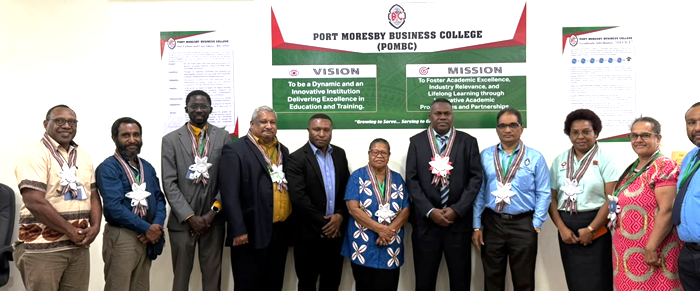
ON THE OCCASION OF THE LAUNCH OF THE NEW PORT MORESBY BUSINESS COLLEGE WEBSITE
Monday, 24 August 2026
John Lasisi August Open Hall
Port Moresby Business College
Principal and members of the Management;
Chairman and members of the Governing Council;
Members of the academic and administrative staff;
SRC and students;
Representatives of industry and our development partners;
Representatives of Universities and Colleges;
Distinguished guests;
DHERST;
Ladies and gentlemen
It is a great pleasure and privilege for me to join you today at the Port Moresby Business College for this important occasion - the official launch of the new institutional website.
I am grateful to be part of this occasion and for having the opportunity to share a few thoughts with you about what this milestone means - not only for this College, but also for the future of higher and technical education in Papua New Guinea.
Let me begin by congratulating the College.
A website may appear, at first glance, to be a relatively simple thing. But in today’s world, the way an institution presents itself, communicates with its students and stakeholders, provides information and connects with the wider community is increasingly important.
So today is not simply about launching a website.
Today is about launching another chapter in the continuing story of Port Moresby Business College.
A PROUD INSTITUTIONAL HISTORY
And that story is worth remembering.
Port Moresby Business College is one of the longstanding institutions in PNG that has contributed to the development of our nation’s human resources.
The institution’s beginning go back to the early 1970s, when it operated as a Clerical College. Over time, it evolved in response to the changing needs of the country and eventually became Port Moresby Business College.
That evolution is important. Because it tells us something about the character of this institution. POMBC has never been an institution that simply stood still. It has changed with the times. It has moved from secretarial training to broader business education. It has expanded the range of programmes it provides. It has responded to changing demands from students, employers and the economy. And for more than five decades, generations of Papua New Guineans have passed through this institution.
Some have become business people. Some have become accountants and administrators. Some have entered government. Some have gone into the private sector. Some have become entrepreneurs. And many have gone on to serve their communities and their country.
That is the true legacy of an institution.
The true measure of a college is not simply the buildings it possesses, or the number of programmes it offers. It is the people it produces and the difference those people make in society.
That is the legacy of POMBC.
BUT LEGACY MUST LEAD TO RENEWAL
However, there is another important lesson we must take from the history of this College.
A proud history is an asset - but it cannot be an excuse for standing still.
The world in which the original Secretarial College operated is very different from the world in which today’s students are preparing to work.
The workplace is changing.
Technology is changing. Business models are changing.
The way people communicate is changing. And the skills employers require are changing.
Artificial intelligence, digital platforms, automation, e-commerce and new forms of entrepreneurship are transforming the way businesses operate.
Therefore, an institution that has survived and contributed to PNG’s development for more than five decades must now ask itself:
What must we become for the next fifty years?
That is the bigger question behind today’s website launch.
The POMBC of 2030 must be different from the POMBC of 2020. And the POMBC of 2040 must be different again.
That is not a sign that the institution has lost its identity. It is a sign that it has remained true to its purpose.
Because the purpose of education is to prepare people for a future that does not yet exist.
ALIGNING INSTITUTIONAL TRANSFORMATION WITH THE NATIONAL REFORM AGENDA
The transformation we are talking about today must also be understood within the broader reform agenda of the Government for higher and technical education in Papua New Guinea.
The reform agenda is seeking to build a higher and technical education system in which our institutions are stronger, more responsive, more accountable and better equipped to deliver quality education and training that meets the needs of industry and the nation.
One of the important directions of this reform is the movement towards empowered institutions operating under a semi-autonomous model, supported by strong institutional leadership and governance, while DHERST provides the necessary regulatory oversight.
This is an important shift.
It means that institutions must increasingly take ownership of their development, their performance, their systems and their engagement with students, industry and the communities they serve.
At the same time, DHERST must ensure that the system as a whole maintains quality, accountability, national standards and alignment with Government’s development priorities.
The reform agenda also places emphasis on quality delivery to industry standards; the development of national training packages and curricula; stronger engagement with industry and the private sector; targeted funding and infrastructure development; and the continuous upskilling of our educators.
These are not abstract policy objectives. They have very practical implications for our institutions such including Port Moresby Business College. POMBC must be an institution that is capable of responding to the needs of employers and the economy.
It must be an institution that embraces technology and innovation. It must strengthen its engagement with industry and the private sector. It must continue to invest in its people, its systems and its infrastructure. And it must have the institutional capacity to make decisions, implement its plans and demonstrate results.
This is what institutional empowerment and reform ultimately mean: giving our institutions greater capacity to lead their own development, while ensuring that they remain accountable for the quality and outcomes they deliver.
Today’s occasion fits very comfortably within that reform direction.
A modern, accessible and responsive digital presence is one of the practical tools an empowered institution needs to communicate, engage, provide information, promote its programmes, connect with industry and demonstrate its performance.
FROM STRATEGY TO IMPLEMENTATION
There is another reason why I believe today’s occasion is important.
In 2025, Port Moresby Business College launched its Strategic Plan 2026–2030.
That plan provides the College with a clear direction for the next five years and identifies the key result areas through which POMBC intends to strengthen its performance, relevance and sustainability.
A strategic plan, however, is only as valuable as its implementation.
And today, I want to commend the College for beginning to translate that strategy into action.
In particular, today’s website launch speaks directly to Key Result Area 5 – Providing Infrastructure and Digital Transformation, which calls for the modernisation of ICT facilities and systems.
This is therefore not simply an ICT project. It is an example of strategy being translated into something tangible and visible.
Today’s initiative also contributes to Key Result Area 4 – Providing Good Governance, Leadership and Institutional Sustainability, particularly in relation to improving information management, reporting systems, marketing and public relations with stakeholders.
A modern institutional website can strengthen the way POMBC communicates with students, parents, employers, government, development partners, alumni and the wider community.
There is also a connection to Key Result Area 6 – Ensuring Graduate Employability, Social Responsibilities and Industry Engagement.
A strong digital presence gives the College a platform through which it can showcase its programmes, engage industry, connect with alumni, promote partnerships and communicate the achievements of its students and graduates.
And there is a further connection to Key Result Area 1 – Ensuring Academic Excellence in Teaching and Learning, particularly the College’s commitment to the effective integration of ICT into teaching and learning.
So, I would encourage us not to see today’s event as simply the launching of another website. I see it as an early and visible demonstration that the POMBC Strategic Plan 2026–2030 is moving from a strategic document into implementation.
It should become visible in the decisions we make, the investments we prioritise, the systems we build, the services we provide and, most importantly, the outcomes we deliver for our students.
Today’s event is therefore small but important step in that journey.
And I encourage the leadership of POMBC to continue making that connection between strategy, investment and implementation visible to your staff, students, Council and stakeholders.
DIGITAL TRANSFORMATION - FROM A WEBSITE TO A DIGITALLY ENABLED INSTITUTION
This brings me to the broader question of digital transformation.
The website is an important first step, but it should not be the destination.
The National Higher and Technical Education Plan 2026-2035 calls for an adaptive higher and technical education system that is responsive to digital transformation and national development imperatives. It also identifies ICT infrastructure, skilled human resources, quality assurance, effective partnerships and stronger institutional systems as important foundations for the future.
This means that our institutions must progressively become more digitally enabled - not simply in the way they communicate with the public, but also in the way they teach, manage information, provide services and engage with students and industry. The launch of this website is therefore very much aligned with the direction in which our higher and technical education system must move.
The new POMBC website should therefore be seen as a platform.
A website is a platform; transformation is what we do with that platform. Can it make information more accessible to students?
Can it make communication with parents and stakeholders easier? Can it improve the way the College engages with employers?
Can it showcase the achievements of its students and graduates? Can it connect alumni back to the institution?
Can it provide better access to information about programmes, admissions and opportunities?
And can this be the beginning of a broader digital transformation of the College? I believe the answer must be yes.
Over time, I would like to see POMBC continue this journey into digital student services, stronger online learning resources, improved institutional information systems, digital records, stronger engagement with industry and more effective communication with students and graduates.
Our objective is not simply to put government and institutional services online.
Our objective is to make education more accessible, more responsive, more transparent, more relevant and more connected to the needs of our people and our economy.
THE IMPORTANCE OF BUSINESS EDUCATION
This is particularly important for POMBC because business education has a special role to play in this country.
Papua New Guinea does not only need people looking for jobs. We need people who can create jobs.
We need young Papua New Guineans who can identify opportunities, establish businesses, manage finances, use technology, understand markets, employ people and solve problems.
We need accountants who understand modern business. We need managers who can lead ethically.
We need entrepreneurs who are prepared to take calculated risks.
We need ICT professionals who understand how technology can transform businesses.
We need hospitality and tourism professionals who can help PNG compete in a global market.
And we need graduates who can move confidently between employment, entrepreneurship and further education.
This is why the work of POMBC matters.
The College has an important role in preparing Papua New Guineans not merely to participate in the economy, but to help build the economy.
STRENGTHENING THE CONNECTION WITH INDUSTRY
That also means we must strengthen the relationship between our institutions and industry.
Our higher and technical education system must ensure that the education and training we provide remain relevant to the needs of the labour market and the changing economy.
I therefore encourage POMBC to continue strengthening its partnerships with employers and industry. Ask industry:
What skills do you need? Ask employers:
What are our graduates missing? Ask entrepreneurs:
What prevented you from succeeding?
And then bring those lessons back into the classroom. That is how we make education relevant.
It is also how we ensure that the Strategic Plan is not simply an institutional document, but a living framework that guides decisions about programmes, partnerships, infrastructure, technology and student outcomes.
TO THE STUDENTS
To the students of Port Moresby Business College, I want to say this: You are studying at an institution with a proud history.
You are also studying at a time when the opportunities before you are enormous.
But the world will not wait for you. You must prepare yourselves.
Do not think only about passing examinations. Develop your digital skills.
Develop your communication skills. Learn how to work with people.
Learn how to solve problems. Learn how to manage money.
Learn how to start and manage a business.
Learn how to use technology.
And above all, develop the confidence to create your own opportunities. PNG needs your ideas, your energy and your courage.
The qualification you receive from POMBC should not be the end of your learning.
It should be the foundation for lifelong learning, further education, employment, entrepreneurship and service to your community and your country.
TO THE STAFF AND MANAGEMENT
To the management and staff of POMBC, I also offer a challenge. You have inherited a proud institution.
Your responsibility is not simply to preserve it. Your responsibility is to renew it.
Protect its history. Respect its traditions.
But do not allow tradition to prevent innovation.
The Strategic Plan has provided you with the roadmap.
Today’s website is one example of putting that roadmap into action. The challenge now is to continue.
Every strategic objective should eventually be reflected in something tangible - an improved service, a stronger programme, a better facility, a new partnership, a more efficient system, a stronger student outcome or a new opportunity for your graduates.
That is how institutions demonstrate performance. That is how strategies become results.
And that is how POMBC will continue to build its reputation as a dynamic and innovative institution.
TO THE GOVERNING COUNCIL AND LEADERSHIP
To the Governing Council and leadership, I encourage you to think boldly about the next phase of POMBC’s development.
How do we modernise the institution? How do we strengthen quality?
How do we improve student outcomes? How do we expand partnerships?
How do we strengthen entrepreneurship? How do we make better use of technology?
How do we strengthen our engagement with industry?
And how do we ensure that a young person who enters this institution today leaves not only with a qualification, but with the confidence and capability to contribute meaningfully to PNG?
These are the questions that should define the next chapter.
And I believe the Strategic Plan 2026–2030 provides the framework through which those questions can be answered.
CONCLUSION
Ladies and gentlemen, Today we launch a website.
But I believe we should see something bigger in this occasion.
We are seeing an institution with a long and proud history taking another step forward.
From its roots in clerical training in the early 1970s, through its evolution into Port Moresby Business College, POMBC has demonstrated that institutions must evolve as the nation evolves.
And now, in 2026, this institution is once again embracing change. That is something to celebrate.
But it is also something to build upon.
Let this website be more than a new page on the internet. Let it be the front door to a new chapter for Port Moresby Business College.
Let it represent greater openness. Greater accessibility.
Greater connectivity. Greater innovation. And greater ambition.
But above all, let it be remembered as one of the early tangible steps in implementing the POMBC Strategic Plan 2026-2030.
Because ultimately, the success of that plan will not be measured by the quality of the document launched last year.
It will be measured by what changes on the ground.
It will be measured by the quality of education our students receive. It will be measured by the relevance of our programmes.
It will be measured by the strength of our partnerships.
It will be measured by the opportunities available to our graduates.
It will be measured by the efficiency and responsiveness of our institution. And it will be measured by the contribution POMBC continues to make to PNG.
The best way to honour the history of Port Moresby Business College is not simply to remember what this institution has achieved over the past five decades.
The best way to honour that history is to ensure that the next generation can look back and say: in 2026, POMBC once again chose to move forward.
On behalf of the Department of Higher Education, Research, Science and Technology, I congratulate the Principal, the Governing Council, management, staff and students of Port Moresby Business College on this important milestone.
I encourage you to continue building on your proud history, implementing your Strategic Plan, embracing digital transformation, strengthening your partnerships and preparing your students for the opportunities and challenges of the future.
With those words, it is my pleasure to join you in celebrating and officially launching the new Port Moresby Business College website.
Congratulations, POMBC, and I wish you every success for the next chapter of your journey.
Thank you, and God bless.
Mr. Lonnie Baki, BA, GCQA, MGPP
Secretary